


-
{The Brussels Musical Instruments Museum Oboe Collection}
Stefaan Verdegem - Koninklijk Conservatorium Brussel
-
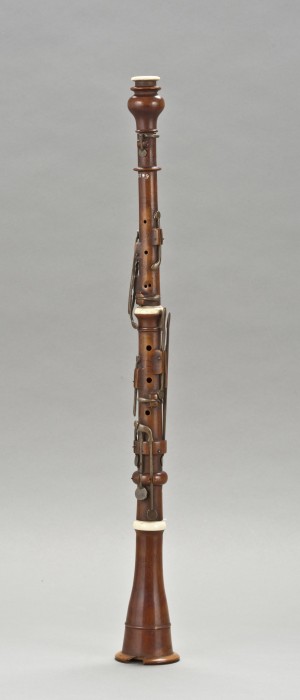
-
IND ?> Inv. number
3579
-
CN/NP ?> Common name / Nominal Pitch
Oboe in C
-
TS ?> Type or system
12-keyed Sellner-type oboe
-
MK ?> Maker
Schott
-
IN ?> Mark, inscriptions
LES FILS / DE B. SCHOTT / A ANVERS – on all 3 parts.
- PL ?> Place of origin [Mainz]
- DM ?> Date of making Between 1824 and 1840.
- MATERIALS Boxwood with ivory and boxwood mounts, brass keys.
- MEASUREMENTS
- Body Length 545mm
- TJ length (body + tenon) 212mm + 17mm
- MJ length (body +tenon) 201mm + 20mm
- B length 131mm
- Acoustic Length 312mm
- BORE
- Minimal bore 4.6mm (measured from the top, the tuning slide being stuck).
- Reed well diameter 6.7mm
- Bore at end of TJ 8.3mm
- Bore at top of MJ 11.4mm
- Bore at end of MJ 14mm
- Bore at top of B 17.6mm
-
TECHNICAL DESCRIPTION
Multi-keyed Sellner-system oboe with 12 keys / 14 touches (duplicates for Bb and F).
Keys with round short-soldered flat flaps, all mounted on woodblocks.
On TJ: Schleifklappe (slur key or octave key), D or C# trill for L3, C for R1, Bb for R1 with duplicate for L0, G# for L4;
On MJ: F# for R4, cross-F with duplicate for L4, C-C#-Eb, Left Eb for L4, low B with long lever on back of the instrument (worked into thumb rest) for L0, key on bell.
SATK (springs attached to the key).
Raised key rings circular.
Milled out key-holes.
3rd hole doubled with finger cove.
No vent-holes nor inner rim on bell.
-
FL ?> Faults
Fair condition. Bell chipped. The bell bottom boxwood mount is probably a repair or replacement of a missing ivory mount. Long lever for low B on the back of the instrument is broken-off in the middle.
-
CS ?> Case
Leather-covered wood case with key. Gold imprint ‘Ch WECKESSER’ on lid. Oboe fits in 3 parts. There is no space for a 2nd tuning slide (cf. Schott oboe MIM 2332).
Dimensions: (LxDxH) 370 x 120 x 75mm.
-
UP ?> Usable Pitch
Several pads missing or stuck. ‘Instant repair’ was needed for testing, giving A= c.440–442Hz with tuning slide completely in (could not be pulled out, stuck) and with reed TL 62mm / staple 38mm / tip width 8mm.
-
PC ?> Performance Characteristics
Slender ‘classical’ sound with character, a little bright.
Instrument plays easily. Easy high register and 3rd octave even without the use of the speaker;
Rather even intonation as far as the oboe could be satisfactorily evaluated (most keys do not close very well).
This seems to be a very good instrument.
-
PO ?> Previous Ownership
Ex-A.Weckesser
- FM ?> Further information on maker
-
SR ?> Specific literature Reference
Verdegem (2008a) pp.211–6.
-
IR ?> Illustration reference
Verdegem (2008a) p.250.
- GL ?> General literature (about this type of instrument)
-
Comparable instruments
Brussels: Schott oboe MIM 2332 and E.horn MIM 2620.
See also Verdegem (2008a) pp.211–216 and pp.246–250 for more comparable instruments.
-
Remarks
Oboe type based on the Viennese ‘Sellner-oboe’ made by Stephan Koch and others, but without the metal cylinders Koch normally used for the tuning slide.
See Verdegem (2008a) and Mahillon (R1978) Vol.IV p.199 on place of origin. The Schott Mainz firm produced wind instruments between 1818 and 1840, and had shops in Mainz, Antwerp (from c.1824), Brussels (from 1833), Paris and London, but the instruments were always made in the Mainz workshop.
It is not unimaginable that this instrument came to Belgium through the agency of Jean-Valentin Bender, who was on good terms with the Schott brothers. Being of German origin himself, he was from 1826 the conductor of the Antwerp Société d’Harmonie and from 1832 the founder and conductor of the famous Belgian military Band of Guides.
{Schott}

